
Although edibles are becoming more common in the United States because of legalization efforts, marijuana can still be addictive. Here, we’ll take a look at the side effects of edibles, their impact on the brain, and what to do if you’re concerned about your use.
What Are Edibles?
Edibles are made by extracting tetrahydrocannabinol (THC), the psychoactive ingredient in marijuana, into an oil or butter that is used in cooking the food product. They can be made at home or commercially made. Some examples include:
- Candies
- Baked goods
- Chocolates
- Gummies
- Beverages
People also smoke marijuana. The main difference between eating and smoking is in how your body processes the THC. This leads to differences in how long it takes to take effect, the amount of time the effects are felt, the intensity of the effects, and the impacts on your health.
Smoking provides a nearly instantaneous effect that fades within a couple of hours, but edibles take longer to kick in. However, once they do, the effects last longer and are more intense.
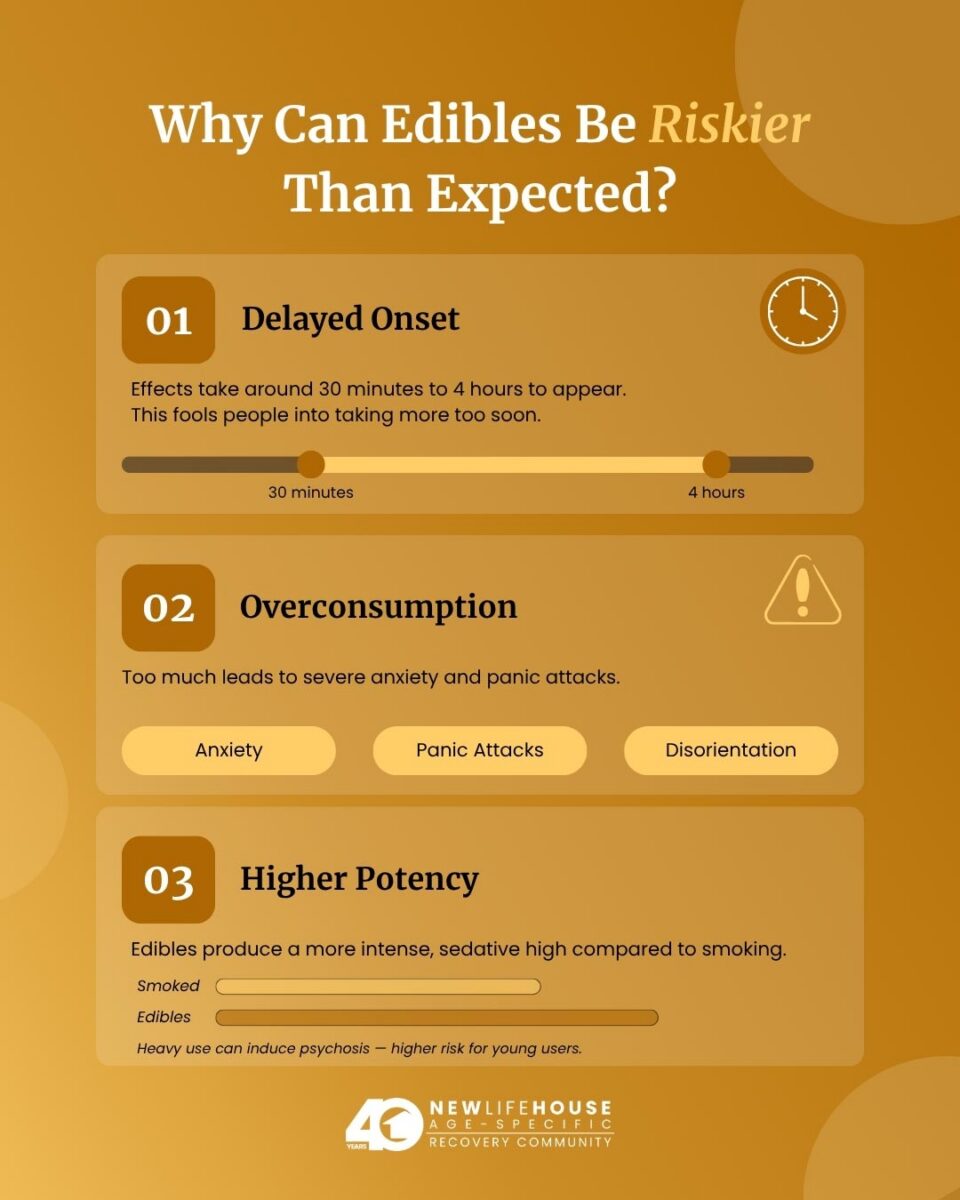
Why Can Edibles Be Riskier Than Expected?
Smoking has its own risks, but marijuana edibles are often riskier than expected. This is due to several reasons.
What Are The Cons Of Taking Edibles?
The cons/risks of taking edibles include:
- Delayed onset – Depending on the product, it may take 30 minutes to four hours for you to feel any effects. You may be tempted to take more, which leads to overconsumption.
- Overconsumption – Overconsumption can lead to symptoms like severe anxiety or panic attacks.
- Higher potency – Marijuana edibles are generally more potent than when you smoke cannabis. This produces a more intense, sedative high. Heavy, high-potency cannabis use can also induce psychosis, with a higher risk for younger users. [1]
Is It Safer To Eat Edibles Than Smoking?
No, studies have also found an increased risk of marijuana poisoning and overdose when consuming edibles in comparison to smoking it. [2]

What Are the Physical Side Effects of Edibles?
The physical side effects of edibles can be more severe than if you were to smoke marijuana. These side effects include:
- Cardiovascular stress, increased heart rate, and elevated blood pressure (posing a risk to those with heart conditions).
- Gastrointestinal distress like nausea, vomiting, and abdominal pain (especially with higher doses).
- Loss of coordination, dizziness, and slowed reaction times.
- Other general physical discomforts, like dry mouth and red eyes, are also common.
Because edibles have a delayed onset, there is a higher risk of overconsumption. Overconsumption can lead to cannabis toxicity. [3] Symptoms associated with cannabis toxicity include severe sedation, dizziness, increased heart rate, and intense anxiety.
What organ is affected by edible cannabis?
Several organs are affected by edibles, including the brain, heart, and the digestive system (short-term). [4]
The Impact of Cannabis Edibles on Developing Brains
Recent cannabis use (within 24 hours) has an immediate impact on your thinking, attention, memory, movement, and time perception. However, there are also long-term effects that many people are unaware of.
The brain continues developing until around age 25. [5] This means that developing brains (like those in babies, children, and teenagers) are especially at risk of the negative effects of marijuana use. Using cannabis before age 18 may affect the way your brain creates connections for functions like attention, memory, and learning. [6]
Because using marijuana during adolescence is linked to memory issues and poorer concentration, it can affect learning and school achievement.
Prenatal cannabis exposure has also been linked with long-term problems with attention and behavior in children. [7]
Can You Overdose on Edibles?
Yes, very high doses of edibles can produce symptoms that linger for many hours (or even days). Some symptoms associated with an edible overdose include increased heart stress, agitation, hallucinations, nausea, vomiting, delusions, paranoia, and psychosis.
Is It Safe To Take Edibles Daily?
It is not generally recommended to use marijuana edibles every day. This is because they can carry several significant short and long-term risks. Some of these risks include:
- Cardiovascular issues – Daily cannabis use is linked to a higher risk of cardiovascular disease, heart attacks, and strokes. [8]
- Tolerance and dependence – Daily use can lead to tolerance, which means you’ll need higher doses to achieve the same effects. This can also lead to cannabis use disorder.[9]
- Mental health impacts – Daily use can worsen or even trigger mental health conditions, such as anxiety, depression, and psychotic symptoms. [10]
- Cognitive decline – For adolescents and young adults, long-term cannabis use is associated with memory loss and impacts the ability to process new information.
- Disrupted sleep quality – Although some people use cannabis edibles as a sleep aid, taking them every night can backfire over time, reducing sleep quality.
When buying edibles, it’s important to inspect them carefully. While some cannabis edible manufacturers are transparent about their products, it may not always be possible to know what you’re getting. A 2015 study took a closer look at 75 different edible products and examined them for proper dosage and label accuracy. [11] Out of these products, they found that 23% contained more THC than stated, and only 17% were accurately labeled.
Cannabis edibles can also interact with supplements and other medications you may be taking. It’s always important to speak with your doctor before using edibles.
Related: Is Marijuana Safe if it is 100% Natural?
Are Edibles Addictive?
Whenever you take any kind of drug, you are at risk of developing a problem. A common misconception is that marijuana is natural and safe to consume. However, regular use can contribute to tolerance. Over time, you may need to use more to reach the desired effect.
It is possible to become physically and mentally dependent on cannabis edibles. Recognizing these signs can help you know if it’s time to seek professional treatment.
Some signs of cannabis use disorder include:
- Using cannabis in larger amounts and for longer than you intended.
- Having a strong urge or desire to use cannabis.
- Spending a lot of time getting, using, or recovering from the effects of cannabis.
- Having problems fulfilling your responsibilities at work, home, or school due to use.
- Despite ongoing physical or psychological problems that are made worse by it.
- Developing a tolerance to cannabis.
- Continuing to use cannabis even when it causes issues in your relationships.
- Experiencing withdrawal symptoms or cravings. [12]
If left untreated, cannabis use disorder can hurt your physical and mental well-being. Professional treatment can help you understand why you use cannabis edibles and set you up for successful recovery.
Related: How to Tell if Cannabis Use in Young Adults Has Moved Beyond “Recreational”
What are the Treatment Options Available for Cannabis Use Disorder?
There isn’t one single approach for cannabis use disorder. Because an FDA-approved medication to treat cannabis use disorder doesn’t exist, the main treatment pathways rely on therapy and support. Combining therapeutic approaches may be best depending on you and your circumstances. These may include:
- Therapy and counseling – Evidence-based therapy can help you understand why you use edibles, identify your specific triggers, and develop healthier coping skills. These techniques can include dialectical behavior therapy, cognitive behavioral therapy, and motivational interviewing.
- Holistic therapies – Addiction is often tied to lifestyle, stress, and habits. Things like mindfulness, yoga, breathwork, fitness, and creative outlets can enhance your well-being and support your healing.
- Group and family therapy – Connecting with others who truly understand your struggles helps you stay accountable, while family therapy gets your loved ones involved in your recovery process.
How New Life House Can Help
Cannabis may be more socially acceptable now that legalization is increasing across the United States. However, that doesn’t mean that use doesn’t come with risks. New Life House offers cannabis addiction treatment that provides the structure and support you need to break free.
When you choose New Life House, you’ll receive:
- Specialized outpatient treatment services that address your mental health and addiction concerns.
- Support from an encouraging community that understands your struggles.
- Comprehensive life skills programs to help you build self-confidence.
- A substance-free residence where you can embark on your sobriety journey.
- Family counseling to help heal relationships affected by your substance use and restore trust.
- Daily therapeutic programming that keeps you accountable and helps you establish healthy patterns.
Our team is dedicated to helping you reach your mental health and wellness goals. With the right tools and support, long-term recovery is possible.
Ready to learn more about our programs and whether they’re right for you? It’s time to break free from your substance use challenges and discover proven recovery methods with the help of New Life House and our recovery community. Contact us today to get started on your journey.
References
- Johnson EC, Agrawal A. Cannabis and Psychosis: Weeding Out Fact from Fiction. Mo Med. 2024 Sep-Oct;121(5):333-339. PMID: 39421474; PMCID: PMC11482844. https://pmc.ncbi.nlm.nih.gov/articles/PMC11482844/
- National Academies of Sciences, Engineering, and Medicine; Health and Medicine Division; Board on Population Health and Public Health Practice; Committee on the Health Effects of Marijuana: An Evidence Review and Research Agenda. The Health Effects of Cannabis and Cannabinoids: The Current State of Evidence and Recommendations for Research. Washington (DC): National Academies Press (US); 2017 Jan 12. 2, Cannabis. Available from: https://www.ncbi.nlm.nih.gov/books/NBK425762/
- Kelly BF, Nappe TM. Cannabinoid Toxicity. [Updated 2023 Jul 10]. In: StatPearls [Internet]. Treasure Island (FL): StatPearls Publishing; 2026 Jan-. Available from: https://www.ncbi.nlm.nih.gov/books/NBK482175/
- Barrus DG, Capogrossi KL, Cates SC, Gourdet CK, Peiper NC, Novak SP, Lefever TW, Wiley JL. Tasty THC: Promises and Challenges of Cannabis Edibles. Methods Rep RTI Press. 2016 Nov;2016:10.3768/rtipress.2016.op.0035.1611. doi: 10.3768/rtipress.2016.op.0035.1611. PMID: 28127591; PMCID: PMC5260817. https://pmc.ncbi.nlm.nih.gov/articles/PMC5260817/
- Arain M, Haque M, Johal L, Mathur P, Nel W, Rais A, Sandhu R, Sharma S. Maturation of the adolescent brain. Neuropsychiatr Dis Treat. 2013;9:449-61. doi: 10.2147/NDT.S39776. Epub 2013 Apr 3. PMID: 23579318; PMCID: PMC3621648. https://pmc.ncbi.nlm.nih.gov/articles/PMC3621648/
- National Institute on Drug Abuse. (2024, September). Cannabis (Marijuana). National Institute on Drug Abuse. https://nida.nih.gov/research-topics/cannabis-marijuana
- Wu CS, Jew CP, Lu HC. Lasting impacts of prenatal cannabis exposure and the role of endogenous cannabinoids in the developing brain. Future Neurol. 2011 Jul 1;6(4):459-480. doi: 10.2217/fnl.11.27. PMID: 22229018; PMCID: PMC3252200. https://pmc.ncbi.nlm.nih.gov/articles/PMC3252200/
- Chandy M, Jimenez-Tellez N, Wu JC. The relationship between cannabis and cardiovascular disease: clearing the haze. Nat Rev Cardiol. 2025 Jul;22(7):467-481. doi: 10.1038/s41569-025-01121-6. Epub 2025 Jan 23. PMID: 39849111. https://pubmed.ncbi.nlm.nih.gov/39849111/
- Connor JP, Stjepanović D, Le Foll B, Hoch E, Budney AJ, Hall WD. Cannabis use and cannabis use disorder. Nat Rev Dis Primers. 2021 Feb 25;7(1):16. doi: 10.1038/s41572-021-00247-4. PMID: 33627670; PMCID: PMC8655458. https://pmc.ncbi.nlm.nih.gov/articles/PMC8655458/
- Hall W, Degenhardt L. Cannabis use and the risk of developing a psychotic disorder. World Psychiatry. 2008;7(2):68-71. doi: 10.1002/j.2051-5545.2008.tb00158.x. PMID: 18560513; PMCID: PMC2424288. https://pmc.ncbi.nlm.nih.gov/articles/PMC2424288/
- Vandrey, R., Raber, J. C., Raber, M. E., Douglass, B., Miller, C., & Bonn-Miller, M. O. (2015). Cannabinoid Dose and Label Accuracy in Edible Medical Cannabis Products. JAMA, 313(24), 2491. https://doi.org/10.1001/jama.2015.6613
- Connor JP, Stjepanović D, Budney AJ, Le Foll B, Hall WD. Clinical management of cannabis withdrawal. Addiction. 2022 Jul;117(7):2075-2095. doi: 10.1111/add.15743. Epub 2022 Jan 10. PMID: 34791767; PMCID: PMC9110555. https://pmc.ncbi.nlm.nih.gov/articles/PMC9110555/