

Kratom, otherwise known as 7-OH, has suddenly been banned at smoke shops and gas stations. Across the country, regulators are responding to growing evidence that 7-hydroxymitragynine (7-OH) is a potent, addictive, and dangerous compound that’s been marketed in misleading ways and sold with little to no oversight.
What’s especially concerning is how easily these products have found their way into everyday spaces and places where you wouldn’t expect to encounter something that acts on opioid receptors in the brain. Understanding what 7-OH is, how it differs from traditional kratom leaf, and why states are moving toward bans can help you make safer, more informed decisions for yourself and the people you care about.
What is 7-OH?
7-hydroxymitragynine, often called 7-OH, is a powerful alkaloid connected to the kratom plant, native to Southeast Asia. In nature, 7-OH appears only in very small amounts in kratom leaf. The problem begins when manufacturers isolate, synthesize, or concentrate the substance into high concentrations that the human body was never meant to ingest.
Research shows that 7-OH binds strongly to opioid receptors in the brain, and in some cases, with greater potency than morphine. Due to this, 7-OH can cause effects similar to classical opioids, including euphoria, sedation, dependence, and respiratory depression [1,2].
Many products containing 7-OH have been marketed as dietary supplements, energy boosters, or natural pain relief. The Food and Drug Administration (FDA) has made it clear that these products are unapproved and unlawful as foods or supplements [1,3].
Related: The Rise of 7oh Kratom Abuse (7-hydroxymitragynine)

How is 7-OH different from kratom?
Traditional kratom leaf is a plant material that contains multiple alkaloids, including mitragynine and trace levels of 7-OH. When used traditionally in Southeast Asia, the leaf was brewed or chewed in relatively low, natural concentrations.
7-OH products sold in gas stations and smoke shops today are very different. Most are created by:
- Isolating or synthesizing 7-OH from kratom
- Increasing concentration levels far beyond what occurs naturally
- Selling it in powders, gummies, shots, or capsules that are easily accessible to the public
At these concentrated levels, 7-OH acts more like a pharmaceutical opioid than a plant-based substance. These concentrated levels of 7-OH are why regulators view it as a major concern for public health [1,4].
Related: Kratom: This “Herbal Medicine” Is More Like an Herbal Monster
Why the 7OH ban is happening
The push for a 7oh ban isn’t about demonizing plants or traditional medicine. It’s about protecting people from a substance that is:
- Potent and habit-forming
- Linked to severe withdrawal symptoms, overdose deaths, and addiction
- Sold without dosage standards, safety testing, or consistent labeling
- Aggressively marketed to consumers who may not understand the risks
The FDA has reported increasing calls to poison centers, hospitalizations, and deaths associated with products containing concentrated 7-OH [1,5,6]. In response, the administration has taken enforcement actions, seized products, and urged the Drug Enforcement Administration (DEA) to consider scheduling 7-OH under the Controlled Substances Act due to its high abuse potential and lack of accepted medical use [1,7].
Related: Kratom Overdose: Dangers, Symptoms, and What You Should Know
What is the controversy with kratom?
Kratom sits at the center of an ongoing substance use debate. Some people turn to kratom use while trying to manage pain, anxiety, or symptoms related to opioid use disorder. Others are exposed through marketing that frames kratom products as harmless or natural.
The controversy grows when companies exploit that perception by:
- Adding synthesized or concentrated 7-OH
- Marketing products with vague or misleading health claims
- Selling to young adults without clear warnings about addiction risk
Without FDA approval, standardized dosing, or long-term safety data, consumers are left guessing, and that uncertainty has real consequences [1,4].
Related: Kratom Addiction: What is it and When to Get Help
Is kratom illegal under federal law?
As of now, the kratom leaf itself is not illegal under federal law. However:
- The FDA has repeatedly warned that kratom products are not approved as drugs, foods, or health supplements
- Products containing added or concentrated 7-OH are considered unlawful
- Federal agencies are actively evaluating scheduling options for 7-OH under the Controlled Substances Act [1,7]
In other words, availability does not equal safety, and it doesn’t mean these products will remain legal.
Related: Is Kratom Addictive?
What states are banning 7-OH?
An increasing number of states and local governments are moving to ban or strictly regulate 7-OH due to overdose risk, poison center reports, and concerns about addiction and respiratory depression.
States that have already taken action or are actively pursuing bans or strict restrictions on 7-OH include:
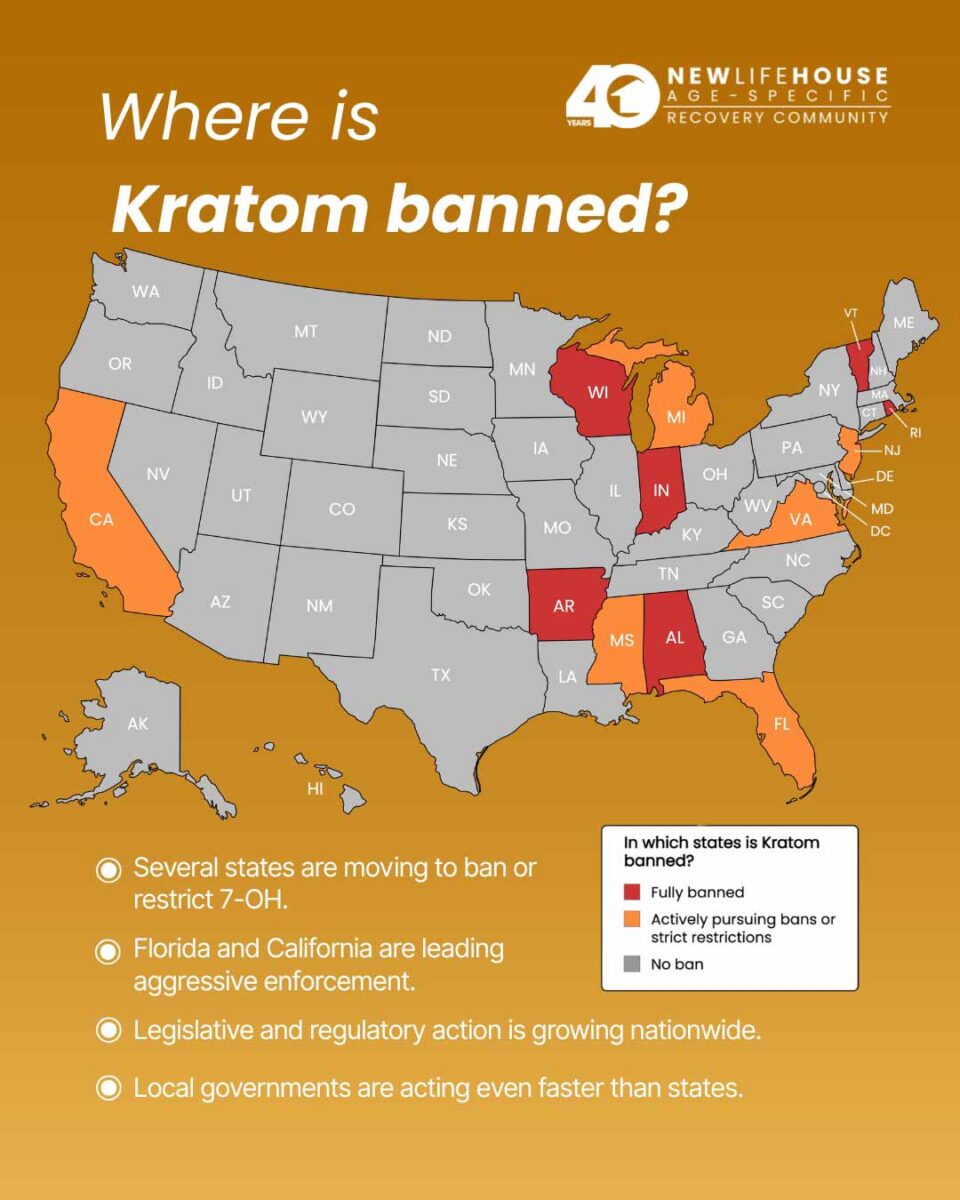
- Florida: Emergency scheduling and proposed permanent Schedule I classification
- California: State enforcement combined with aggressive county-level action, including Los Angeles County
- New Jersey: Legislative proposals to classify 7-OH as a controlled substance
- Missouri: Proposed restrictions targeting concentrated 7-OH products
- Michigan: Active regulatory debate and public health investigations
- Virginia: Public health guidance aligned with FDA recommendations to restrict 7-OH
- Other states allow kratom leaf, but are moving to restrict or ban 7-OH specifically
- On the local level, many cities and counties have enacted local bans, even where state law still allows kratom
Despite these efforts, 7-OH products still find their way onto shelves even faster than enforcement can keep up. That’s why education and awareness are just as important as regulation [5,6,9].

Moving forward: awareness, regulation, and recovery
The growing momentum behind the 7-OH ban reflects something important: people are paying attention. Regulators, healthcare providers, and the public are starting to see that these products are potent opioid-like compounds with real risks.
If you or someone you love has been using 7-OH or other kratom products and feels stuck, dependent, or unsure how to stop, support matters. Recovery is about understanding what you’re up against, getting the right help, and building a life that doesn’t depend on substances that put your health at risk.
At New Life House, we support young men and their families at our sober living in Los Angeles with personalized kratom addiction treatment. We’ll guide you through recovery with structure, accountability, and community. With our individualized programming, family therapy, parent support groups, and peer connection, you can learn how to stay sober, rebuild trust, and move forward with confidence.
References
- Office of the Commissioner. (2025, July 29). FDA Takes Steps to Restrict 7-OH Opioid Products Threatening American Consumers. U.S. Food And Drug Administration. https://www.fda.gov/news-events/press-announcements/fda-takes-steps-restrict-7-oh-opioid-products-threatening-american-consumers
- Kruegel, A. C., Uprety, R., Grinnell, S. G., Langreck, C., Pekarskaya, E. A., Rouzic, V. L., Ansonoff, M., Gassaway, M. M., Pintar, J. E., Pasternak, G. W., Javitch, J. A., Majumdar, S., & Sames, D. (2019). 7-Hydroxymitragynine is an active metabolite of mitragynine and a key mediator of its analgesic effects. ACS Central Science, 5(6), 992–1001. https://doi.org/10.1021/acscentsci.9b00141
- Office of the Commissioner. (2025, July 29). Products containing 7-OH can cause serious harm. U.S. Food And Drug Administration. https://www.fda.gov/consumers/consumer-updates/products-containing-7-oh-can-cause-serious-harm
- Office of the Commissioner. (2025, July 15). FDA issues warning letters to firms marketing products containing 7-Hydroxymitragynine. U.S. Food And Drug Administration. https://www.fda.gov/news-events/press-announcements/fda-issues-warning-letters-firms-marketing-products-containing-7-hydroxymitragynine
- Office of the Commissioner. (2025, December 2). FDA seizes 7-OH opioids to protect American consumers. U.S. Food And Drug Administration. https://www.fda.gov/news-events/press-announcements/fda-seizes-7-oh-opioids-protect-american-consumers
- Serious Illnesses Associated with 7-OH Use | Texas DSHS. (n.d.). https://www.dshs.texas.gov/news-alerts/serious-illnesses-associated-7-oh-use
- FDA recommends restricting 7-OH products. (2025, July 31). Environmental Health. https://www.vdh.virginia.gov/environmental-health/2025/07/31/fda-recommends-restricting-7-oh-products/
- National Institute on Drug Abuse (NIDA). (2022, May 27). Kratom. National Institute on Drug Abuse. https://nida.nih.gov/research-topics/kratom
- LISTING OF DEPARTMENT OF PUBLIC HEALTH PRESS RELEASES. (n.d.). https://publichealth.lacounty.gov/phcommon/public/media/mediapubhpdetail.cfm?prid=5179