

Kratom is often marketed as a “natural” or “herbal” supplement that can boost mood or relieve pain, but what many people don’t realize is that this plant-based substance can have serious, or even life-threatening effects when used in high doses or combined with other drugs.
While some people believe kratom is a safe alternative to opioids, the risk of overdose is real, and the emergence of stronger forms like 7-hydroxymitragynine (7-OH Kratom) has made the danger even greater.
Worried about your loved one’s kratom use?
You don’t have to navigate the uncertainty alone. Our evidence-based support and strong recovery community can help you heal.
What is kratom, and how does it work?
Kratom (Mitragyna speciosa) is a tropical tree native to Southeast Asia. At lower doses, kratom can increase energy and alertness; at higher doses, it can cause euphoria, drowsiness, and pain relief (effects similar to prescription opioids) [1,2].
Because kratom isn’t regulated by the U.S. Food and Drug Administration (FDA), its purity and potency can vary widely. Products sold in smoke shops or online might contain far higher levels of active compounds than expected, especially when mixed with other ingredients or marketed as “concentrated” kratom [3].
In 2016, the Drug Enforcement Administration (DEA) attempted to classify the main compounds in kratom as Schedule I substances alongside other drugs like heroin, cocaine, fentanyl, psychedelics, and more [7]. Their intention was met with a lot of public pushback, and it landed on labeling kratom as a drug of concern. Years later, kratom has exploded in popularity, with widespread marketing, easier access, and growing concern over dependence and misuse.
Related: What is Kratom?
Can you overdose on kratom?
Yes, it’s possible to overdose on kratom, particularly when taken in large quantities or alongside other substances. Studies have found that more than 90 deaths between 2016 and 2017 involved kratom, and nearly all also involved other drugs such as fentanyl, benzodiazepines, or alcohol [4].
Overdose occurs because kratom can slow the nervous system, leading to dangerous symptoms like slowed breathing, loss of consciousness, seizures, or cardiac arrest. Since kratom acts on the same brain receptors as opioids, combining it with other sedatives dramatically raises the risk of respiratory depression and death.
Related: Is Kratom Addictive?
7-OH kratom: A potent and unregulated threat
One of the most alarming developments in recent years is the rise of 7-hydroxymitragynine (7-OH Kratom), which is a potent form of kratom’s main active compound. In its natural form, kratom already has mild opioid-like effects. But 7-OH Kratom is exponentially stronger. Some studies estimate it’s up to 13 times more potent than morphine [5].
Deceptive 7oh marketing
7-OH Kratom is often sold in drinks, capsules, or tablets that look like prescription pills such as Xanax bars or blue “M30” oxycodone tablets. These products are marketed in gas stations and smoke shops as harmless “wellness drinks,” “energy boosters,” or “relaxation aids,” and their packaging and design frequently appeal to young people. Teenagers and young adults might believe they’re taking something natural and safe.
Unregulated products are dangerous
Because 7-OH Kratom products are largely unregulated, manufacturers aren’t required to list accurate ingredients or potency levels. Some batches have been found to contain synthetic opioids or other additives, further increasing the risk of overdose and poisoning [6].
Public-health officials warn that this lack of oversight creates a dangerous illusion of safety. Stronger regulations and consumer protections are urgently needed, but until those changes happen, these products remain easily accessible and deceptively marketed. Unfortunately, this combination has already led to tragic outcomes.
Related: The Rise of 7oh Kratom Abuse (7-hydroxymitragynine)
What the experts have to say:
What should not be taken with Kratom?
Kratom can be especially dangerous when combined with other substances that depress or overstimulate the nervous system. According to the Los Angeles County Department of Public Health, many serious cases of kratom overdose involve polysubstance use, meaning mixing kratom alongside one or more of the following [2,4]:
- Opioids (heroin, oxycodone, fentanyl): amplify sedation and suppress breathing
- Benzodiazepines (Xanax, Valium): increase risk of respiratory failure
- Alcohol: worsens liver toxicity and central-nervous-system depression
- Stimulants (cocaine, amphetamines): strain the heart and increase the likelihood of seizures
- Prescription painkillers or antidepressants: unpredictable and sometimes lethal interactions
Even over-the-counter drugs or herbal supplements can interact dangerously with kratom because its alkaloids compete with other medications for liver metabolism. You should treat any combination of these substances as a medical emergency and seek help immediately.
Recognizing the signs of a kratom overdose
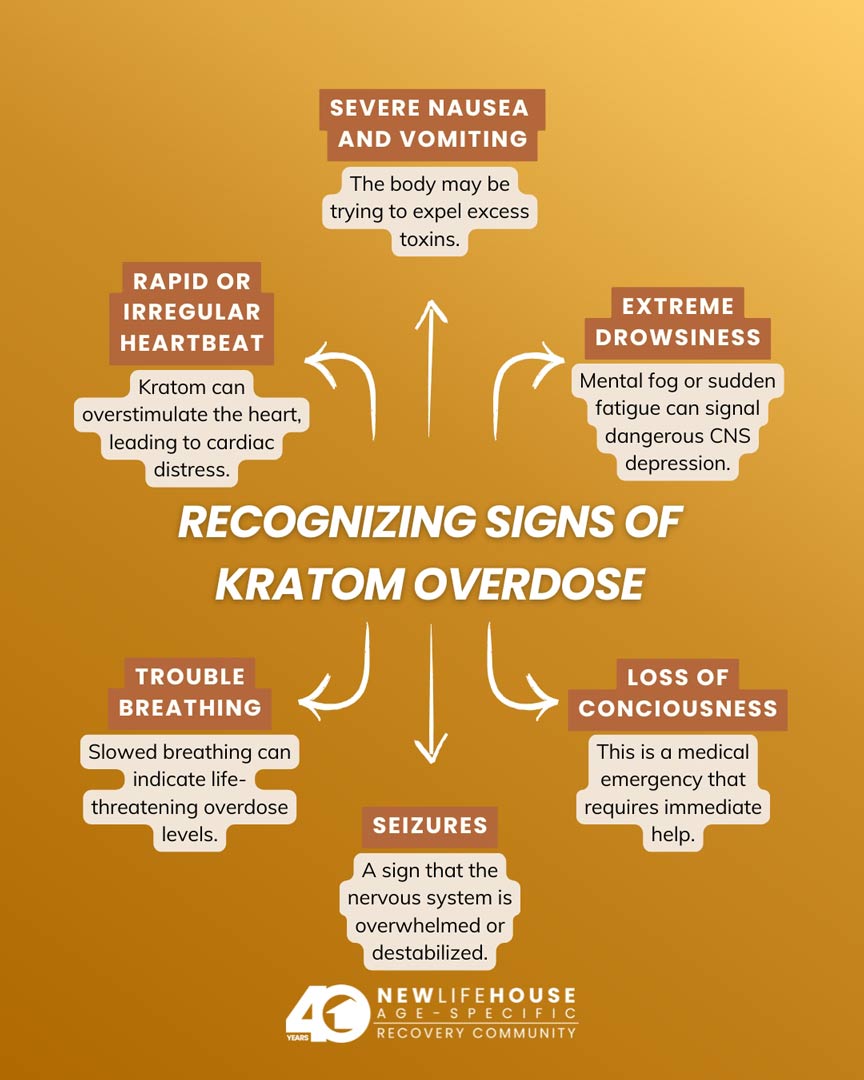
Recognizing overdose symptoms quickly can save a life. Common warning signs include:
- Severe nausea and vomiting
- Confusion or extreme drowsiness
- Rapid or irregular heartbeat
- Trouble breathing or shallow respiration
- Seizures
- Loss of consciousness
Unlike opioid overdoses, kratom overdoses don’t always respond to naloxone (Narcan) because kratom isn’t a traditional opioid. Naloxone may still be helpful in mixed-substance situations; however, always call 911 if you suspect an overdose.
What to do if you suspect a kratom overdose
If someone shows signs of overdose:
- Call 911 immediately.
- Do not try to make them vomit or “sleep it off.”
- If trained and available, administer naloxone (it’s safe even if opioids aren’t involved).
- Place the person on their side to keep their airway clear.
- Stay with them until medical professionals arrive.
After emergency care, a medical evaluation is essential. Ongoing kratom misuse can lead to dependency, withdrawal symptoms, and worsening mental health challenges.
Related: What to Do After an Overdose
Kratom addiction treatment options
Like other forms of substance abuse, kratom misuse often begins with self-medication for pain, opioid withdrawal, anxiety, or stress, but dependence can form quickly. Detoxing from kratom may cause withdrawal symptoms such as muscle aches, irritability, insomnia, and intense cravings [1,3].
Kratom addiction treatment usually involves medical supervision during detox, behavioral therapy, and supportive environments that help individuals rebuild structure and accountability. For families, connecting a loved one to a recovery program that offers community, support, and long-term guidance can make all the difference in preventing relapse and restoring stability.
Find the right support for lasting recovery
Healing from chronic kratom misuse takes time, but no family has to go through it alone. Reach out today to learn more about treatment options that promote accountability, connection, and real recovery.
Recovery is possible
At New Life House, we recognize just how serious kratom misuse has become, especially with potent, unregulated versions like 7-OH Kratom available over the counter in gas stations, smoke shops, and online markets. The lack of oversight and misleading “herbal supplement” marketing makes it easier for people to underestimate the risks. Stronger regulation and education are needed to prevent more fatal overdoses and protect vulnerable young adults who may see kratom as harmless.
Our sober living program in Los Angeles provides the structure, accountability, and peer community that can make lasting recovery possible. Whether kratom was the first introduction to drug abuse or part of a longer struggle with addiction, we can help you get sober, rebuild healthy routines, reconnect with your family, and learn how to sustain real change. Recovery from kratom addiction is possible, and we’re here to guide you along the way.
References
- Kratom: Unsafe and ineffective. (n.d.). Mayo Clinic. https://www.mayoclinic.org/diseases-conditions/prescription-drug-abuse/in-depth/kratom/art-20402171
- LISTING OF DEPARTMENT OF PUBLIC HEALTH PRESS RELEASES. (n.d.). https://publichealth.lacounty.gov/phcommon/public/media/mediapubhpdetail.cfm?prid=5139
- What is the Kratom overdose risk? A Systematic literature review. (2022). In Current Addiction Reports [Journal-article]. Springer Nature Switzerland AG. https://kslegislature.gov/li_2024/b2023_24/committees/ctte_h_fed_st_1/documents/testimony/20230201_16.pdf
- Olsen, E. O., O’Donnell, J., Mattson, C. L., Schier, J. G., & Wilson, N. (2019). Notes from the Field: Unintentional Drug Overdose Deaths with Kratom Detected — 27 States, July 2016–December 2017. MMWR Morbidity and Mortality Weekly Report, 68(14), 326–327. https://doi.org/10.15585/mmwr.mm6814a2
- Ahmed, S., Tran, Q. V., & McLean, M. (2023). The great Imitator: a case of accidental Kratom overdose. Cureus. https://doi.org/10.7759/cureus.43144
- Sladky, M., & Banta-Green, C. (2025). Kratom & 7-OH: what do we know about use, safety, and overdose risk?
- DEA announces intent to schedule kratom. (2016, August 30). DEA. https://www.dea.gov/press-releases/2016/08/30/dea-announces-intent-schedule-kratom