
When someone thinks about addiction, they usually think about drugs or alcohol. However, behavioral addictions (also known as process addictions) can be just as damaging. Compulsive behaviors can take over a person’s life, affecting their work, relationships, and mental health. Additionally, substance use disorders may co-occur with process addictions since they often share underlying triggers. Addressing both issues during treatment can enhance the recovery process.

What Is a Behavioral Addiction?
A behavioral addiction is a strong urge to engage in certain types of behaviors despite the negative consequences. Although these behaviors provide a temporary escape, they often lead to emotional, physical, or financial harm. These addictions can be as serious as substance addictions.
What Do Behavioral Addictions and Substance Addiction Have in Common?
Despite being different, behavioral addictions and substance use disorders often co-occur. All addictions share similar characteristics, including the inability to stop compulsive behaviors, even when it negatively affects your life. Additionally, behavioral addictions are often accompanied by drug and alcohol use, which creates an unhealthy cycle that is difficult to break. For the best chances at long-term recovery, both conditions must be addressed simultaneously.
Types of Process Addictions
There are many kinds of process addictions. Many of these activities may start out as coping mechanisms that turn into harmful patterns. Over time, you may need to engage in the behavior more often to get emotional relief.
Gambling Addiction
Gambling addiction is one of the most common types of process addictions.1 Someone with a gambling addiction feels compelled to gamble even when it leads to financial loss and emotional distress. They may chase their losses, lie about how much they gamble, and use it to escape stress.
Social Media Addiction
Social media addiction is characterized by excessive use of social media.2 Those affected experience intense urges and withdrawal similar to chemical dependency. Their use may significantly disrupt their relationships, mental health, and daily life.
Video Game Addiction
Feelings of loneliness and isolation are what often drive video game addictions.3 While video game addiction can happen to anyone, it is more prevalent among teens and young adults. Teenagers are at a higher risk of video game addiction due to having less mature coping skills. Their brains are also developing.
Pornography Addiction
Someone with porn addiction compulsively watches porn despite their efforts not to.4 They often lose track of time when viewing porn and may lose interest in real sex. Although not a formal diagnosis, it is often treated as a compulsion, where the brain becomes dependent on dopamine-driven stimulation.
Internet Addiction
Internet addiction is when someone stays online for most of their day and is unable to control their use.5 Internet addiction disorder often leads to isolation, lost productivity, and sleep issues.
Shopping Addiction
Shopping addiction is characterized by an urge to buy things even if you don’t need or want them.6 It is often driven by an urge to escape negative emotions or feel a temporary high. Shopping addiction often leads to financial issues.
Food Addiction
Food addiction refers to compulsive eating behaviors.7 It is often linked to emotional distress. Food addiction may lead to serious health issues and negative consequences.
Exercise Addiction
Those with an exercise addiction may feel guilty or anxious if they have to miss a workout.8 They may push themself past their personal limits at the gym, which can lead to injury. An obsession with physical fitness may interfere with their daily life.
What Causes Process Addictions?
Most process addictions start off as habits that are harmless or even positive. However, over time, these habits can turn into compulsions that become hard to control. This is because of a shift in the brain’s reward system. When we do something we like, our brains release a “feel-good” chemical called dopamine.9 This dopamine release reinforces that behavior, making you want to do it again.
Over time, that behavior turns into a way to avoid stress, to quiet emotional pain, or fill a void in your life. The consequences of process addiction are significant and include financial issues, lost jobs, and worsening mental health disorders. For this reason, process addiction treatment often involves exploring emotional regulation, trauma, and other underlying health concerns.
How Can I Know If I Have a Process Addiction?
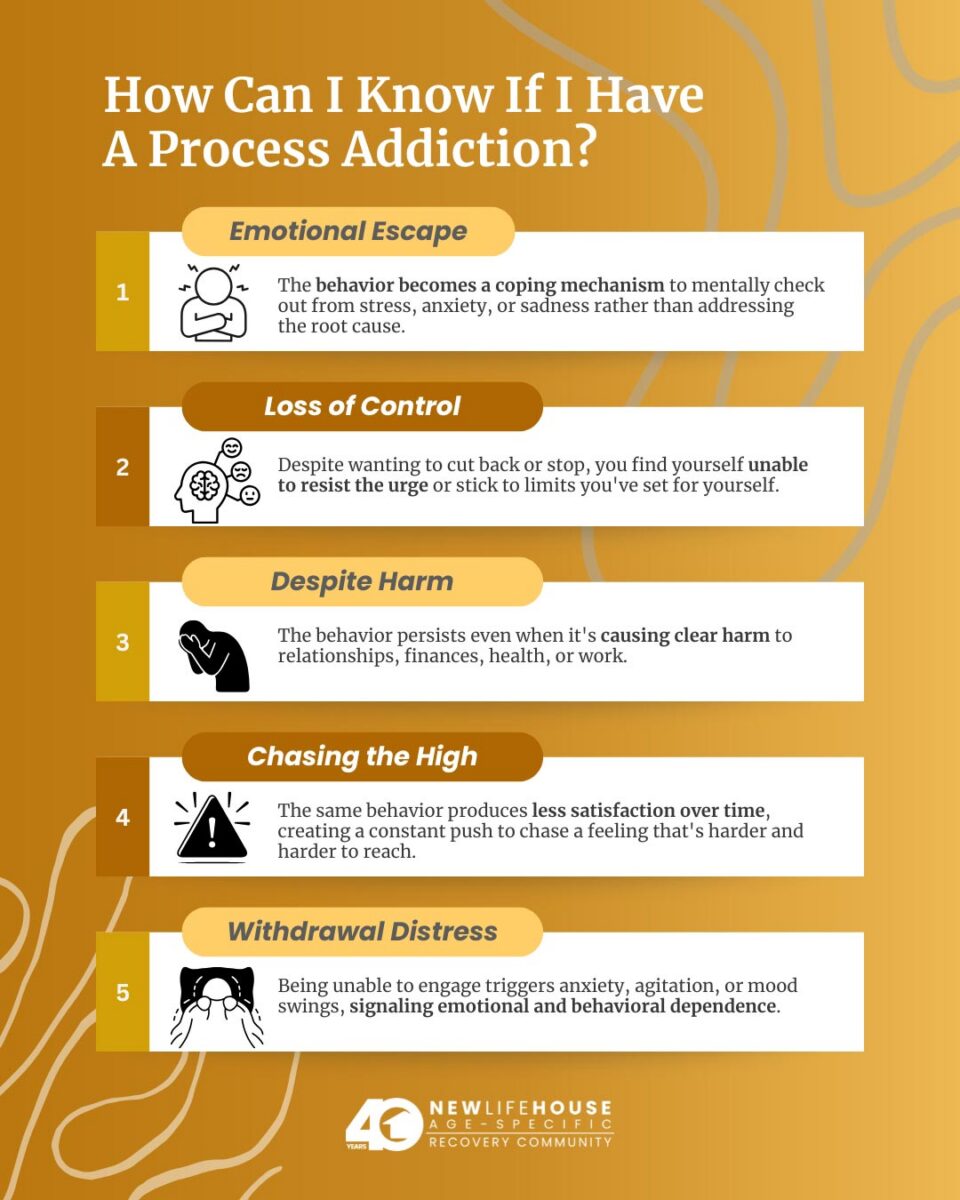
If you suspect that you or someone you know has a behavioral addiction, there will be signs.10 The most common one is spending an excessive amount of time thinking about or actively involved in the behavior, while ignoring other activities, people, and responsibilities. Here are a few other things to look for:
- Using the behavior to escape from negative emotions.
- Loss of control over the behavior.
- Continuing to engage in the behavior despite negative consequences.
- Compulsively seeking the “high” from the activity.
- Feeling distressed and irritable when unable to engage in the activity.
While behavioral addiction is different from drug addiction, it is similar in many ways. However, the “substance” is a behavior instead. In some cases, people may even experience withdrawal symptoms similar to substance use disorders, like restlessness, agitation, and mood swings.
What Are the Risk Factors of Process Addictions?
A combination of factors may increase your chances of developing a process addiction. They include:
- Family history of addiction
- Childhood trauma
- Recent trauma
- Co-occurring mental health disorders
- Personality traits like high stress sensitivity or impulsivity
- Lack of healthy coping skills and emotional regulation
Social pressure and the pressure to fit in are also reasons behind some behavioral addictions (like social media and exercise addiction). Understanding these causes can help you identify the signs of process addiction and seek treatment early.
How Behavioral Addiction Crosses Into Substance Abuse
Process addictions and substance abuse both activate the brain’s reward pathway. As dopamine increases, the ability to regulate impulse control decreases. This increases your vulnerability to switching off between that behavior and drugs.11 Process addictions are more likely to develop in those who struggle with substance use and vice versa.
At the same time, drug and alcohol abuse can fuel a process addiction. For example, alcohol is one of the most commonly abused substances. The more you drink, the lower your inhibitions become, which is why casinos often give away free drinks.
Having a process addiction and a substance use disorder can create additional issues. They may also turn to a different addiction to cope. This cycle creates a downward spiral that many people become trapped in.
Related: How to Get Sober: A Guide to Breaking the Cycle of Addiction
How Is Behavioral Addiction Treated?
Behavioral addiction treatment involves a combination of approaches, including psychotherapy, support groups, and behavioral intervention. One of the most effective approaches is cognitive behavioral therapy (CBT). Cognitive behavioral therapy helps people identify their triggers, change destructive thought patterns, and build healthier coping mechanisms. Other approaches include:
- Dialectical behavior therapy (DBT) – Helps people manage their emotions and reduce harmful, impulsive behaviors.
- Motivational interviewing – Intended to help a person feel ready to make a change and to seek treatment.
- Support groups and 12-step programs – 12-step programs and group therapy help to reduce shame while receiving support.
- Family therapy – Improves family dynamics while addressing enabling behavior to support recovery.
While there isn’t any medication that’s been approved to treat all behavioral addictions, SSRIs (which are antidepressants) are sometimes used to treat underlying impulsive behaviors or anxiety.12
Dual Diagnosis Treatment for Process Addictions and Mental Health Disorders
If someone is dealing with both substance use and process addiction, it is called a dual diagnosis. It’s important to treat both conditions. Failing to do so can result in an incomplete recovery. Untreated mental health issues or substance abuse can trigger a relapse into behavioral addiction (and vice versa).
By using an integrated treatment approach, you can receive comprehensive care that addresses all aspects of your mental health.

Treating Co-Occurring Disorders and New Life House
Behavioral addiction rarely exists on its own. For many people, it’s tangled up with alcohol or drug use, unresolved trauma, or mental health concerns that have never been fully addressed. When that’s the case, treating one issue without the other can leave the door open for relapse.
That’s where New Life House comes in. Our sober living programs are built around the idea that real recovery happens in the in-between moment, like how you handle a hard day, how you show up for the people around you, and how you start to rebuild a life that actually feels worth living. For someone recovering from a process addiction, that kind of structured, community-based environment is often the thing that makes the difference.
At New Life House, you’ll find:
- Individualized programming tailored to your history, your struggles, and your goals.
- Parent support groups and family therapy to rebuild trust and repair the relationships that matter most.
- Peer community and accountability that helps break the isolation so many process addictions thrive on.
- Educational and life skills programming to help you finish school, find purpose, and grow into who you want to be.
Recovery is about building something better in place of the unhealthy behaviors. If you’re ready to take that step, we’re here.
Frequently asked New Life House questions
Read through our FAQ for any questions you may have or give us a call today. We are here to answer your questions and support you or your loved one through their healing journey.
What is a process addiction?
A process addiction refers to a behavior that a person continues to engage in despite negative consequences. An example would be engaging in shoplifting because of a shopping addiction.
What are the most addictive behaviors?
The most addictive behaviors include compulsive porn use, gambling, and internet use.
How do I know if I have a behavioral addiction?
If you continue to engage in compulsive behaviors despite negative consequences, it could indicate a behavioral addiction. But, there could be many other reasons for this. The best course of action is to reach out to a mental health or addiction professional.
How addictive is gambling?
Gambling can be addictive, but not everyone who gambles regularly develops an addiction to it. However, the unpredictability of it can make it hard to stop.
What are signs of social media addiction?
Signs of this include spending excessive amounts of time online, in spite of negative effects on your life.
References
- Yau YH, Potenza MN. Gambling disorder and other behavioral addictions: recognition and treatment. Harv Rev Psychiatry. 2015 Mar-Apr;23(2):134-46. doi: 10.1097/HRP.0000000000000051. PMID: 25747926; PMCID: PMC4458066. https://pmc.ncbi.nlm.nih.gov/articles/PMC4458066/
- Pellegrino A, Stasi A, Bhatiasevi V. Research trends in social media addiction and problematic social media use: A bibliometric analysis. Front Psychiatry. 2022 Nov 10;13:1017506. doi: 10.3389/fpsyt.2022.1017506. PMID: 36458122; PMCID: PMC9707397.https://pmc.ncbi.nlm.nih.gov/articles/PMC9707397/
- Mohammad S, Jan RA, Alsaedi SL. Symptoms, Mechanisms, and Treatments of Video Game Addiction. Cureus. 2023 Mar 31;15(3):e36957. doi: 10.7759/cureus.36957. PMID: 37009362; PMCID: PMC10065366.
- de Alarcón R, de la Iglesia JI, Casado NM, Montejo AL. Online Porn Addiction: What We Know and What We Don’t-A Systematic Review. J Clin Med. 2019 Jan 15;8(1):91. doi: 10.3390/jcm8010091. PMID: 30650522; PMCID: PMC6352245. https://pmc.ncbi.nlm.nih.gov/articles/PMC6352245/
- Chadha Y, Patil R, Toshniwal S, Sinha N. Internet Addiction Management: A Comprehensive Review of Clinical Interventions and Modalities. Cureus. 2024 Mar 4;16(3):e55466. doi: 10.7759/cureus.55466. PMID: 38571828; PMCID: PMC10988534.https://pmc.ncbi.nlm.nih.gov/articles/PMC10988534/
- Mondal A, Kumar M. Psychological correlates of shopping addiction. Ind Psychiatry J. 2025 May-Aug;34(2):292-297. doi: 10.4103/ipj.ipj_446_24. Epub 2025 Jul 18. PMID: 40861135; PMCID: PMC12373345. https://pmc.ncbi.nlm.nih.gov/articles/PMC12373345/
- Kalon E, Hong JY, Tobin C, Schulte T. Psychological and Neurobiological Correlates of Food Addiction. Int Rev Neurobiol. 2016;129:85-110. doi: 10.1016/bs.irn.2016.06.003. Epub 2016 Jul 22. PMID: 27503449; PMCID: PMC5608024. https://pmc.ncbi.nlm.nih.gov/articles/PMC5608024/
- Guo S, Kamionka A, Xue Q, Izydorczyk B, Lipowska M, Lipowski M. Body image and risk of exercise addiction in adults: A systematic review and meta-analysis. J Behav Addict. 2025 Feb 6;14(1):39-54. doi: 10.1556/2006.2024.00085. PMID: 39912824; PMCID: PMC11974424. https://pmc.ncbi.nlm.nih.gov/articles/PMC11974424/
- Volkow ND, Michaelides M, Baler R. The Neuroscience of Drug Reward and Addiction. Physiol Rev. 2019 Oct 1;99(4):2115-2140. doi: 10.1152/physrev.00014.2018. PMID: 31507244; PMCID: PMC6890985.https://pmc.ncbi.nlm.nih.gov/articles/PMC6890985/
- Grant JE, Potenza MN, Weinstein A, Gorelick DA. Introduction to behavioral addictions. Am J Drug Alcohol Abuse. 2010 Sep;36(5):233-41. doi: 10.3109/00952990.2010.491884. PMID: 20560821; PMCID: PMC3164585. https://pmc.ncbi.nlm.nih.gov/articles/PMC3164585/
- Konkolÿ Thege B, Hodgins DC, Wild TC. Co-occurring substance-related and behavioral addiction problems: A person-centered, lay epidemiology approach. J Behav Addict. 2016 Dec;5(4):614-622. doi: 10.1556/2006.5.2016.079. Epub 2016 Nov 10. PMID: 27829288; PMCID: PMC5370366. https://pmc.ncbi.nlm.nih.gov/articles/PMC5370366/
- Singh G, Singh H, Magny S, Virk I, Gill M. Use of Fluoxetine in Treating Compulsive Sexual Behavior: A Case Report. Cureus. 2022 Sep 16;14(9):e29245. doi: 10.7759/cureus.29245. PMID: 36262958; PMCID: PMC9573801. https://pmc.ncbi.nlm.nih.gov/articles/PMC9573801/