

For many, a drug arrest is often the start of a revolving door in and out of jail. It can be the beginning of a difficult cycle to break free from. However, getting charged with a drug-related crime doesn’t necessarily mean you have to face a traditional court sentence. For some people, a drug diversion program is an alternative to serving jail time.
Drug Diversion: An Alternative to Jail for Minor Drug Offenses
While violent crimes or certain serious charges may not qualify, sometimes, the judge offers a diversion program for substance use. These programs address the root cause of drug use and offer you a second chance at transforming the path you’re on while working towards a life free from addiction.

Why Courts Offer Drug Diversion Programs
Traditional jail time often fails to stop the cycle of arrest and incarceration, especially if substance abuse is involved. Drug diversion programs help stop this cycle. They recognize that substance use is a chronic health issue. These programs help in a variety of ways:
- Reduces the “cycle” of incarceration – These programs provide people with an “exit ramp” from traditional legal systems. This allows them to stay in their community while receiving treatment. These programs also help reduce jail overcrowding, especially for non-violent offenses.1
- Helps treat substance use disorders – Drug diversion programs are evidence-based interventions that help address the medical and psychological aspects of addiction behind criminal activity.2
- Supports rehabilitation – Drug diversion programs provide additional resources to offenders, including educational resources, job training, housing, and social services to help build stability.
- Lowers recidivism – By treating the underlying addiction, participants in diversion programs are less likely to commit more crimes.3
A drug diversion program is a way to avoid jail time. But you should also see it as an opportunity to take that first step towards healing and achieving independence.
Related: What is a Diversion Program?
Who Qualifies for a Drug Diversion Program?
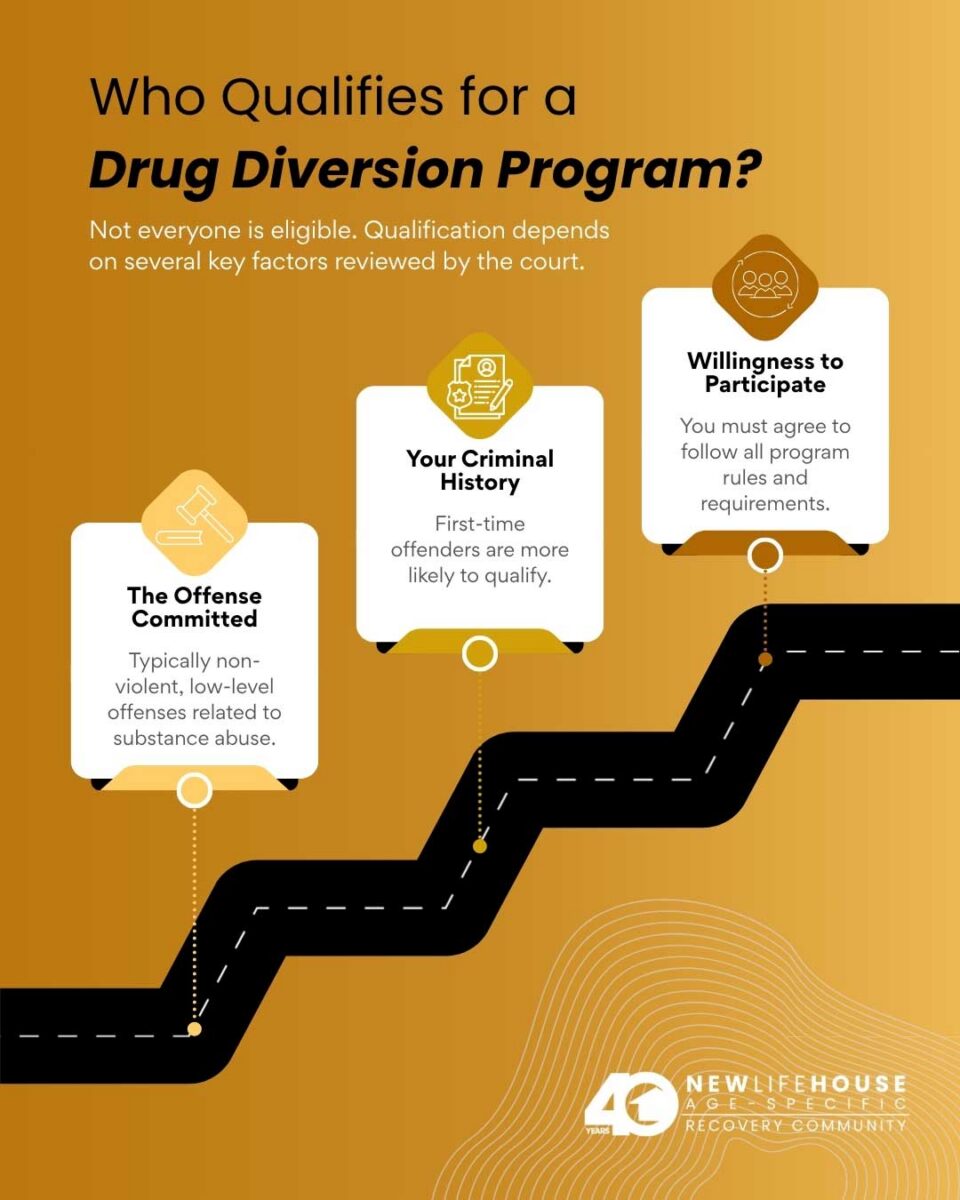
While you may request a diversion program instead of jail time or other punitive measures, not everyone will qualify for it. Your eligibility depends on several factors. These include:
- The offense committed – Those considered for these programs are typically charged with non-violent, low-level offenses related to their substance abuse.
- Your criminal history – First-time offenders are more likely to qualify.
- Willingness to participate – You must agree to follow the program’s rules while completing all of the requirements.
Like adults, juveniles may also be offered diversion programs to help them make better choices and avoid future legal trouble. Their eligibility requirements are similar to those of adults.
Related: Step by Step: How Mental Health Diversion Works in California
What Offenses Are Typically Excluded?
Those charged with serious, violent crimes are not eligible for drug diversion programs. Examples of serious crimes include:
- Violent crimes
- Drug trafficking and sales
- Sexual offenses
- Weapons violations
- Family violence
- Serious felonies
Beyond certain offenses, there are background factors that may not allow participation. For example, if you have had your probation revoked, you may not qualify. Also, if you have previously failed a drug diversion program, that may exclude you from participating again.
What a Drug Diversion Program Looks Like
Most drug diversion programs have more than one component. They help treat the addiction while also holding you accountable for completing each step.
Substance Use Treatment Program
The first step in a drug diversion program is a professional clinical assessment. This assessment helps the mental health team develop a treatment plan tailored especially for your needs.
During the early stages of treatment, the focus is on helping you get stabilized physically, which may include medical detox. Once you are stable medically, you can focus on other parts of the program. These may include residential treatment or inpatient rehab, an outpatient program, or medication-assisted treatment.
Counseling or Therapy
Many drug diversion programs include attending regular group counseling and/or individual therapy sessions. Counseling can help address co-occurring mental health needs.
Many programs also require working through a 12-step program (like Narcotics Anonymous or Alcoholics Anonymous). This helps you create a sober social network.4
Drug Testing
Frequent, random drug testing is the “backbone” of any drug diversion program. Testing usually occurs between 2 and 3 times a week and gradually decreases as you show progress. Any missed or positive tests are immediately reported to the court.
Court Supervision
In a drug diversion program, you work with a team to ensure you fulfill all requirements set by the court. You also appear before a judge regularly to review your progress in the program. The judge can either reward your work (like reducing curfews) or address any violations by assigning you extra tasks (such as additional community service).
Program Completion Requirements
To have your charges dismissed and “graduate” from or successfully complete a drug diversion program, you usually have to meet the following requirements:
- Maintain a minimum period of documented (continuous) sobriety (usually about 4 to 6 months).
- Complete all required counseling and substance abuse education models.
- Show proof of stable employment, housing, or enrollment in higher education.
- You must also make sure to pay back all court-ordered restitution and program fees.
Drug diversion programs follow a structured path where your requirements gradually decrease as you demonstrate your ability to achieve and maintain long-term sobriety.
Drug Diversion vs. Drug Court
There is often confusion about the differences between drug diversion and drug court. In California, there are significant differences in the legal structure and intensity of these two alternatives to traditional jail time.5
While drug diversion is usually for low-level, first-time offenders, drug court is designed for high-risk people with serious substance use disorders. Drug court often requires more frequent drug tests and court appearances. Drug diversion programs are usually supervised by a probation officer or a program administrator, and the amount of oversight is often lower.
Drug diversion programs don’t require a guilty plea. Legal proceedings are put on pause while you complete your program. With drug court, the models usually vary, but many of them are completed “post-plea”, meaning you have to plead guilty first. Then your sentence is deferred (or suspended) while you participate in the program.
Related: From Courtroom to Recovery: How Drug Court and Sober Living Work Together
How Long Drug Diversion Programs Last
The timeline associated with a drug diversion program varies depending on the jurisdiction. However, many of them last for several months up to a year (or longer). Violations and failed drug tests can also affect the length of time you participate in a program.
The Role of New Life House in Drug Diversion
Drug diversion programs require enrollment in a rehabilitation program that provides structure and accountability while offering evidence-based support. New Life House is a sober living home in Los Angeles that offers the opportunity to create a recovery community you can lean on while completing all of your program requirements. Some things we can help with include:
- Creating a unique treatment plan with services coordinated to help you with your particular challenges.
- Providing you with a recovery support team that includes individual therapy, group therapy, and 12-step services.
- Helping you with life skills development and training for long-term success.
- Coordinating with the court system and helping you with legal documentation and fulfilling your community service requirements.
- Offering you comprehensive court support services with the help of our experienced NLH court team.
New Life House is highly experienced in the criminal justice system. We ensure that our clients are prepared and on time for all court dates, with the appropriate paperwork, and provide transportation. We can help guide and keep you on track with any legal requirements you need to fulfill, including fine payments and other matters that are necessary for a successful completion.
Our staff comes from diverse life experiences and educational backgrounds. Many of our members have worked through our programs (including alternative sentencing programs) and understand the road you are facing.
By taking the opportunity to attend and complete a drug diversion program, you’re not only avoiding time spent in jail but also taking a positive step forward towards achieving sustainable wellbeing and a brighter future ahead.
Frequently asked New Life House questions
Read through our FAQ for any questions you may have about diversion programs, or give us a call today. We are here to answer your questions and support you or your loved one through their healing journey.
How long is a diversion program in California?
In California, it varies by jurisdiction. Most drug diversion programs last several months to a year. However, they can take longer.
Are there disadvantages to diversion programs?
If you are terminated from the program, you may face harsher legal penalties, including jail time. The requirements can be intense and also include regular court appearances, random drug tests, and strict compliance with rules and treatment schedules.
Do diversion programs show up on background checks?
Yes, they can show up on background checks. However, they often appear as “pending charges” or as a “dismissal” instead of a conviction.
What is the success rate of diversion programs?
According to research, drug diversion programs may reduce repeated offenses by 26% to 47% when compared to traditional sentencing (like jail time).6
Sources
- Prison Overcrowding in the United States | EBSCO. (2018). EBSCO Information Services, Inc. | Www.ebsco.com. https://www.ebsco.com/research-starters/law/prison-overcrowding-united-states
- Dickson-Gomez, J., Spector, A., Krechel, S., Li, J., Montaque, H. D. G., Ohlrich, J., Galletly, C., & Weeks, M. (2022). Barriers to drug treatment in police diversion programs and drug courts: A qualitative analysis. The American journal of orthopsychiatry, 92(6), 692–701.
- Belenko, S., Hiller, M., & Hamilton, L. (2013). Treating substance use disorders in the criminal justice system. Current psychiatry reports, 15(11), 414. https://doi.org/10.1007/s11920-013-0414-z
- Kelly, J. F., Bergman, B. G., & Fallah-Sohy, N. (2018). MECHANISMS OF BEHAVIOR CHANGE IN 12-STEP APPROACHES TO RECOVERY IN YOUNG ADULTS. Current addiction reports, 5(2), 134–145. https://doi.org/10.1007/s40429-018-0203-1
- Wolfe, E. L., Guydish, J., Woods, W., & Tajima, B. (2004). Perspectives on the Drug Court Model Across Systems: A Process Evaluation. Journal of Psychoactive Drugs, 36(3), 379–386. https://doi.org/10.1080/02791072.2004.10400037
- Belenko, S., Hiller, M., & Hamilton, L. (2013). Treating substance use disorders in the criminal justice system. Current psychiatry reports, 15(11), 414. https://doi.org/10.1007/s11920-013-0414-z